
Developing a robust marketing plan is crucial for any business aiming for success. It involves a comprehensive understanding of both internal and external factors that can influence your marketing goals. By analyzing your strengths and weaknesses, identifying opportunities for growth, and recognizing potential threats, you can strategically position your business for optimal performance. Learn how to connect with your customers on a deeper level, understand their needs, and effectively communicate your unique value in a crowded marketplace.
Components of a Marketing Plan
- SWOT Analysis
- Customer Identification
- Understand Competitors
- Define your Difference
- Map Your Customers’ Journey
- Create Action Plan
- Monitor, Measure, Improve
SWOT Analysis
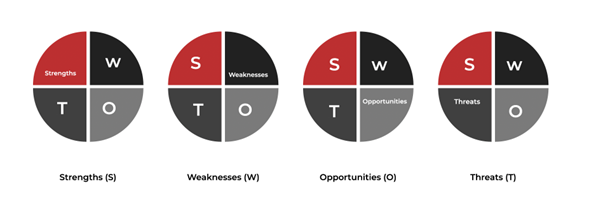
To better understand all sides of your business and to have an effective marketing plan and strategy, you need to do a SWOT analysis.
This helps you understand internal and external factors that can make or break your success toward your marketing goals SWOT analysis looks at the Strengths (what you do well), Weaknesses (what or how you need to improve), Opportunities (what possibilities can you expand your business) and Threats (which are mostly not in your control).
Customer Identification
Who are your customers?
- Demographics (age, income, geography, education)
- Psychographics (behaviour, hobbies, interests)
- How Product/Service serves customers or addresses a “pain point” (fears, needs, worries, gap in the marketplace)
Understand Your Competitors
- Where are they located?
- How long have they been in business?
- What are their target markets?
- What are their unique selling points and competitive differentiation?
- What are their strengths and weaknesses?
The more you know about your competitors, the better equipped you are at improving your business to compete.
Define your difference
Think about how you stand out. There are three ways of articulating how your business is uniquely positioned for success: Through your value proposition, your unique selling point and your mission statement
Value Proposition: This is the value a company promises to deliver to customers should they choose to buy their product. A value proposition is part of a company’s overall marketing strategy.
Unique Selling Point: Your unique selling point is what makes your business different from ever yone else in your market. A strong unique selling point can help you attract and retain customers and reduce client turnover.
Mission Statement: A mission statement is a short statement of why an organization exists, what its overall goal is, identifying the goal of its operations: what kind of product or service it provides, its primary customers or market, and its geographical region of operation. Mission statements help you to see the meaning and purpose of your work by giving you clear reasons why your company benefits a larger goal.
Create an Action Plan
Some of the questions that you can ask yourself to determine which marketing resources to use are:
- What is your marketing budget?
- How much can you afford to spend this year?
- Who is on your marketing team?
- Who is responsible for what?
- What is your pricing strategy?
- How will you distribute your goods or services?
This is not an exhaustive list, and your action plan is based on what kind of business you are looking to start.

Map Your Customers Journey
From the moment your customer first interacts with your business, through to after they have made (or not made) a purchase, it is essential that you communicate your brand appropriately. Keep your customers engaged throughout the journey.
- Attention – How will you make your ideal customer aware of your business?
- Interest – How will you get them interested in your business?
- Desire – How will you create the desire for them to make a purchase?
- Action – How will you get them to take action and make a purchase?
- Loyalty – How will you make them loyal to your business?
Monitor, Measure, Improve
- Monitor – Periodically monitor your sales and your competitors
- Measure – Measure the effectiveness of your marketing strategies and evaluate the return on investment (ROI)
- Improve – Take action on what you have learned from monitoring and measuring
Peter Drucker, Management Consultant, said: “If you can’t measure it, you can’t improve it.”
Define Your Brand
- Your values/mission: Why did you start this business? What is your business’ mission?
- Be strong and recognizable: Recognizable brands often generate more sales and profits
- More than a logo: Your brand should be reflected in everything the company does (documents, website, etc.)
- Project: Your brand should make people feel and think a certain way (safe, high quality, funny, quick ser vice, expensive, etc.)
Elevator Pitch Model

Example:
“There is a lack of quality Filipino food in the city, with a high demand for the food. Our food truck eliminates the need for people to travel outside of the city to find good Filipino food. For more than 15 years in the Philippines, Manny and I ran a successful café in downtown Manila, and we had a big following. By having a food truck, we are bringing the food to where the people are, making it more convenient.
Manny-La is an exciting Filipino food truck concept operated by a mother and son team- Manny and Mila. Filipino cuisine is growing as a new and exciting food option. We strive to make traditional Filipino food more accessible to the people of Toronto, with the city ’s only Filipino food truck. We are looking for some financial backers to support our venture.”